Coyotes
Train DreamsCoyotes are among the clearest signs that the Moyea Valley has not simply recovered from the great fire but has become a different ecological world. They appear at the margins of Robert Grainier’s rebuilding, in the sounds surrounding his cabin, and in the uncertain fate of animals that leave human company for the wild. Their presence gives the burned landscape a continuing animal life while also reminding Grainier that the valley’s future will not restore the world he lost.
Return to the Burn
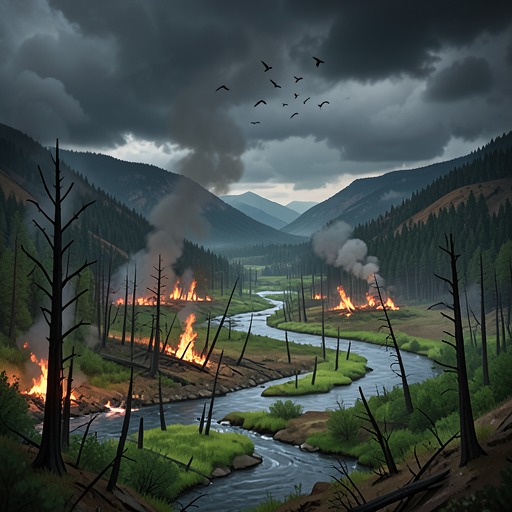
After the fire, Grainier initially imagined the ruined valley as nearly sterile. When he returned to the old homesite, however, he heard wolves answering one another across the peaks, while birds briefly rested during their passage over the burn. The blackened ground was already producing jack pine, and later fireweed and other growth would rise from the ashes. Coyotes belong to this same process of return, but they are associated less with the first astonishment of regeneration than with the tougher, more opportunistic life that follows disturbance.
The contrast between the animals and the ruined human settlement is important. Grainier’s cabin, Bible, household goods, and family have vanished, while animal voices travel through the valley and establish a new soundscape. The fire has destroyed the old domestic order without eliminating life itself. Coyotes therefore help define the burn as a place where human loss and nonhuman persistence coexist: the valley is not empty, but its forms of life no longer answer to the human world Grainier remembers.
Coyotes and Human Companions
Coyotes enter Grainier’s experience most concretely through the fate of his animals. During his first post-fire summer, he keeps a little red-haired female dog, a nanny goat, four hens, and a rooster near his lean-to. The dog lives on goat’s milk, fish heads, and whatever she can catch, and she sometimes wanders away for days. Grainier eventually has to butcher the goat because the bare ground cannot support grazing and the animal’s feed has become expensive; after the second frost, he kills and stews the fowls one by one. The domestic experiment ends with Grainier and the dog having eaten them all, while the surrounding country remains a place where animals must find their own means of survival.
The dog’s uncertain movements place her close to the coyote world. When one wolfish pup from her litter disappears before autumn, Grainier hopes it has crossed into Canada to join its brothers, but he must also assume that a hawk or the coyotes has taken it. The coyotes thus represent a stark alternative to human care: they may be predators, scavengers, or simply the unseen explanation for a disappearance. Their role is not sentimental. They occupy the burned country according to pressures that Grainier cannot control and cannot fully observe.
The broader regional stories reinforce this uneasy proximity. Grainier hears astonishing tales of dogs along the Idaho Panhandle and the Kootenai River—animals credited with rescues, tricks, and humanlike intelligence—and one of his freight jobs involves transporting Peterson, a surveyor for Spokane International Railway who has been shot by his own dog. Peterson attributes the dog’s sudden knowledge to an association with the wolf-girl, treating the animal world as capable of secret communication and dangerous intention. Coyotes are not the agents of that shooting, but they belong to the same narrative environment in which the difference between domestic animal, wild animal, and animal-person becomes difficult to secure.
The Valley’s Night Chorus
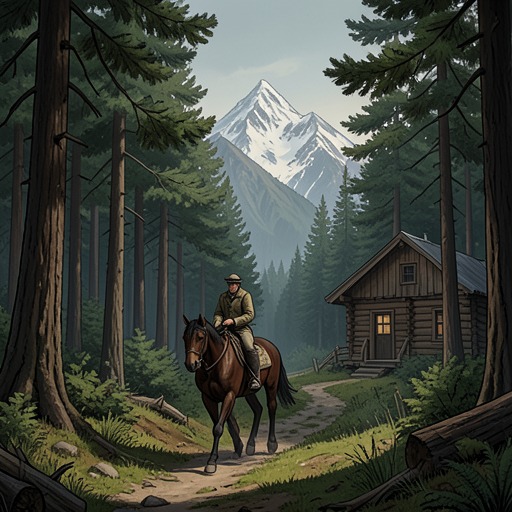
Once Grainier lives in the cabin through the winters, the valley’s apparent silence is repeatedly broken by trains, wolves, coyotes, and his own howling. The coyotes are heard nearer than the distant wolves, their mad jibbering forming the closest wild counterpoint to the railroad’s mechanical rumble. Their voices make the cabin less an isolated refuge than a listening post within a large and active nonhuman territory.
The most concentrated display comes after Kootenai Bob is killed beneath a train. For several cold autumn nights, the Great Northern train blows long whistles as it moves slowly through the area, allowing the Kootenai people time to search the tracks for the scattered remains. The whistle starts the coyotes, and the coyotes in turn start the wolves. Grainier’s red dog is somewhere outside as the chorus grows fuller and more desperate, culminating on the night of the full moon.
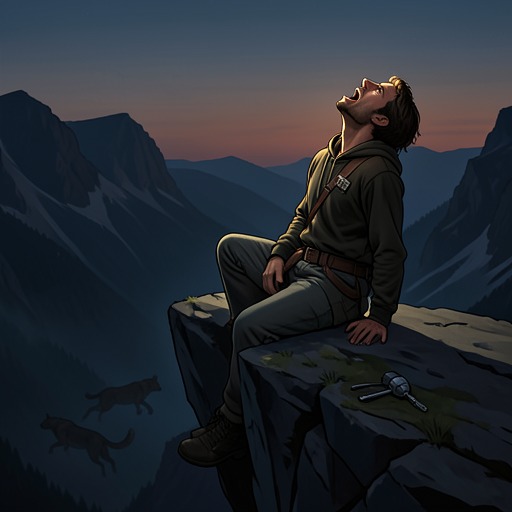
That night the coyotes and wolves howl without letup, seeming to number in the hundreds. Grainier imagines that owls, eagles, and every other creature with a voice on the ridges may have joined them. He cannot identify the entire assembly, but its scale gives it the force of a pronouncement, perhaps even an alarm announcing the end of the world. The sound is not merely background atmosphere. It converts Bob’s death, the railroad’s controlled passage, and the grief of the surrounding animals into one immense disturbance whose meaning Grainier can feel without being able to translate.
The animals then flood into the clearing. Wolves run past Grainier’s doorway, brushing him as they pass, and the valley falls silent except for his footsteps and the panting of the injured wolf-girl left behind. Coyotes are part of the overwhelming chorus that precedes this encounter, helping create the moment in which wildness briefly crosses the threshold of Grainier’s cabin. Their collective voice does not explain the wolf-girl, but it prepares the scene by making the entire valley seem to possess a will beyond human understanding.
Ecological Transformation
In Grainier’s later life, coyotes become evidence of long-term ecological replacement. The valley does not gradually resume its pre-fire condition. The gorgeous spruce disappears; scraggly jack pine becomes dominant; wolves are heard less often and from farther away; coyotes grow numerous; rabbits become increasingly scarce; and trout vanish from long stretches of the Moyea River. This sequence makes coyote abundance part of a larger rearrangement rather than an isolated animal detail.
Their increase is especially meaningful beside the retreat of wolves. Earlier, wolves answer one another across the peaks and provide Grainier with the distant choir to which he sometimes howls. Years later, that sound recedes while coyotes become more common. The change suggests a shift in the valley’s hierarchy of wild animals, one visible through altered numbers, distances, and sounds. What looks superficially like recovery is therefore ecological succession with losses as well as returns: new growth covers the burn, but the old forest, fish, and animal relationships do not come back unchanged.
Coyotes also sharpen the book’s distinction between endurance and restoration. They survive in a landscape where Grainier’s first attempt to live on the old site produces no garden and no substantial structure beyond a lean-to. The animal’s persistence does not heal his grief or replace his family, yet it demonstrates that the valley can support forms of life other than those he associates with home. Their growing presence measures the passage from catastrophe into a new normal, one Grainier eventually accepts without claiming that it is the same as the past.
Narrative Significance
Coyotes occupy a boundary between the ordinary and the uncanny. They are concrete predators that may consume a missing pup, familiar voices in the winter valley, and participants in a vast animal gathering that Grainier experiences as an almost cosmic alarm. Around them, local knowledge and rumor repeatedly blur natural history with legend: Kootenai Bob explains wolf behavior through a rule about breeding, Grainier wonders whether his dog has begun a new pack, and Peterson imagines secret collaboration between his dog and the wolf-girl.
Yet the coyotes are not merely supernatural symbols. Their increasing numbers, their proximity to the cabin, and their relation to the declining wolves and rabbits give them an ecological specificity. They register the consequences of fire across decades, while their howling enters the emotional structure of Grainier’s solitary life. When he listens to or joins the animal chorus, he is not escaping the valley’s history; he is finding a form in which grief, fear, and survival can coexist without becoming human speech.
By the end of Grainier’s life, the coyotes belong to the altered world that has outlasted his memories of the original forest. They help make the Moyea Valley a place of continuing change rather than a monument to the fire. Their presence preserves the fact that destruction can be followed by abundance, but not necessarily by restoration: the valley lives on, and its new life speaks in voices that are nearer, harsher, and different from those Grainier first knew.